IB Calculus Problem 8
The following figure shows part of the graph of the quadratic function \(f\).
The figure is not to scale.
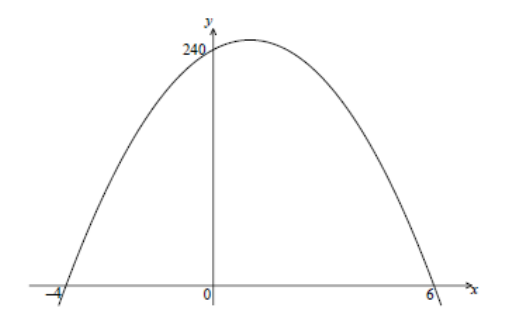
The x-intercepts are at \(( -4; 0 )\) and \(( 6; 0 )\) and the y-intercept is at \(( 0; 240 )\).
- Write down \(f(x)\) in the form \(f(x) = -10(x - p) (x - q)\).
- Find another expression for \(f(x)\) in the form \(f(x) = -10(x - h)^2 + k\).
- Show that \(f(x)\) can also be written as \(f(x) = 240 + 20x -10x^2\).
- A particle moves in a straight line such that its velocity \(v\) ( in \(ms^{-1}\) ),
at time \(t\) (in seconds), is given by \(v = 240 + 20t -10t^2\) , for \(0 \leq t \leq 6\).
- Find the value of \(t\) when the velocity of the particle is greatest.
- Find the acceleration of the particle when its velocity is zero.